


There is a new kid on the block that seems to be shaking up what we “dyed in the wool” fly fishermen hold sacred. It has us questioning our technique, our skill, our pride of years of practice of becoming seasoned anglers. This “Kid”, this trend, is called Tenkara.
Tenkara is not a kid at all; in fact, it is very old. It is a fishing technique that originated in Japan hundreds or millions of years ago, when a pole, a short line and a lure were all you needed to catch a fish. A fishermen back in the day would take this basic combination tool to their streams, catch and keep some fish, and live happily ever after.
Now let’s fast forward a bit. Fishing has become a sport. Fish are caught for the enjoyment of the chase and the fight, and then they are put back in the river for the next fishermen to catch. The equipment has evolved as well. We now have micro-technology rods with specific line speeds and weights, made with exotic woods and sterling silver. Reels that have more engineering involved than the first lunar module and fly lines that float and sink at our will. And a selection of flies for sale that the shear number available surpasses the actual number of living insects. Amazing. Evolution is grand.
Tenkara is here to put a bit of perspective back into our primal needs. It is here, I think, to stay. John Gierach is behind it, Yvon Chouinard is an advocate, and guess what, I think I will follow suite.*
*By no means completely
If you have taken anytime to read some of my other blog posts, you will understand why I would gravitate towards Tenkara. It sums up my deepest personal values in a compact, retractable, graphite package. Please let me explain.
I have spent my entire fishing career pondering exactly why I love fly fishing. As you would expect, there are countless reasons: the hunt, the riddle, the fish, the surroundings, the peace and quiet, mastering my skills, showing up my friends, the stories, and simply, being part of an exclusive club. After a hiatus away from the river, it became clear that there was something I was missing. It was the religion of fly fishing I enjoyed, the Zen of the process I loved, the unity between me and my environment that keeps me coming back. Then, enter Tenkara.

A few years back, Daniel Galhardo of TenkaraUSA set up shop ( I will provide the link to his site to explain his history). My good friend Frank, a fishing and motorcycling buddy of mine, who, also in fact, seems to be in the forefront of undiscovered cool, introduced me to this new style of Japanese fishing. The equipment is simple – it is a smallish telescoping rod, some nylon line, a bit of tippet and a Tenkara fly, which is a sparse wet fly. There is no reel and no ferrels. Think Huckleberry Finn meets the 20th century.
I was intrigued. I asked Frank if he would let me use his Tenkara rods/pole/graphite sticks or whatever you want to call it, and go fishing. He excitedly said yes and made plans to meet at my shop. Frank shows up right on time carrying what appears to be a short metal tube that looked more like an extra long holder for a “Churchill” cigar, one small flybox and a 3-inch custom looking spool wrapped in multi-colored filament, and that’s it.
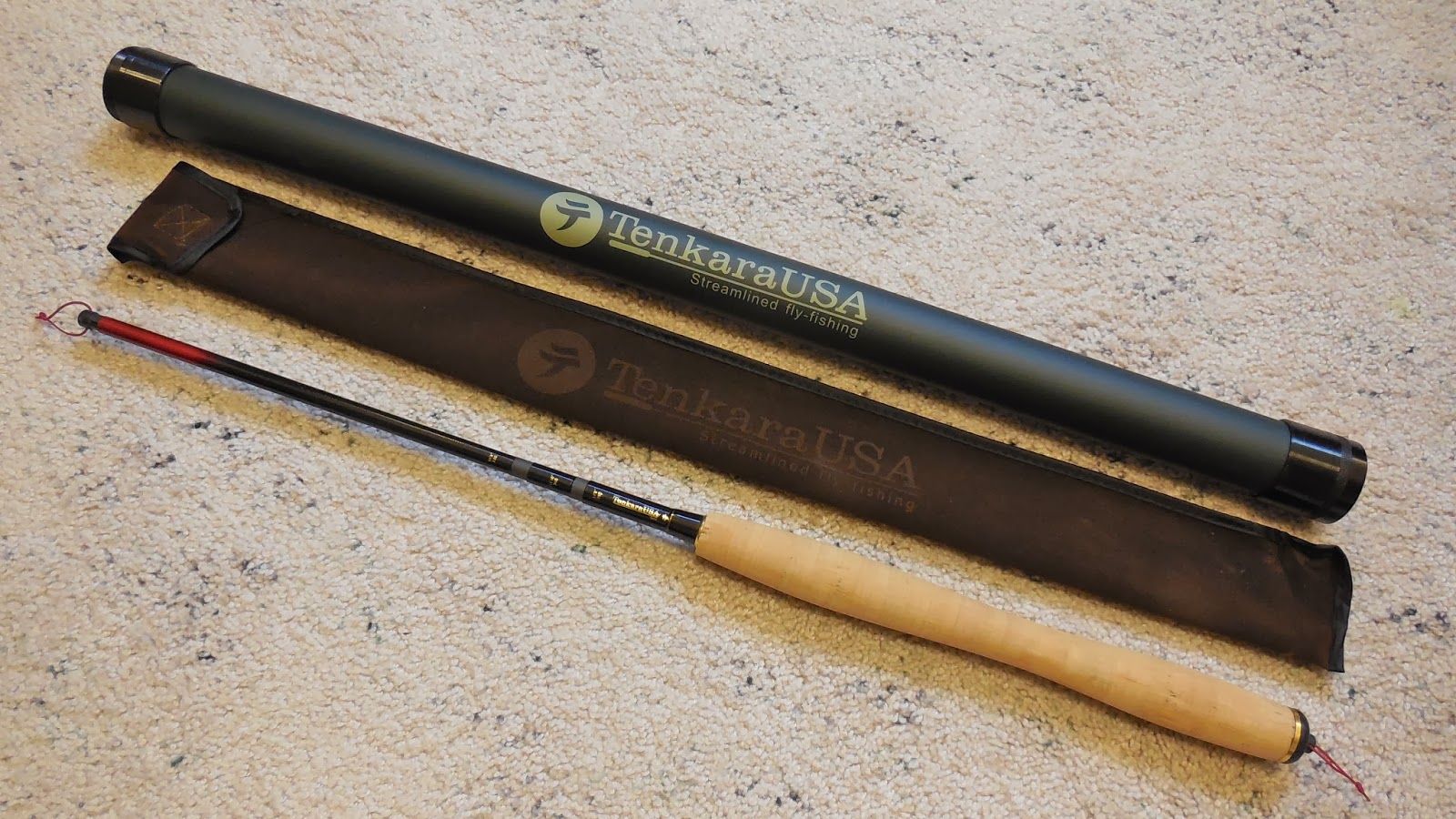
I have all of my gear which is a 5-weight rod and reel, and a fully stocked vest as well as a lanyard…just in case. I placed my rod in the back of his truck, carefully feeding it through the back window to protect the tip. He stuck his Tenkara rod in his back pocket. I have a similar feeling when I go skiing with my snowboarder friends; I carry my boots, poles, and skis. They wear their boots and toss their board in the truck. Very easy, unincombered, and very Zen.
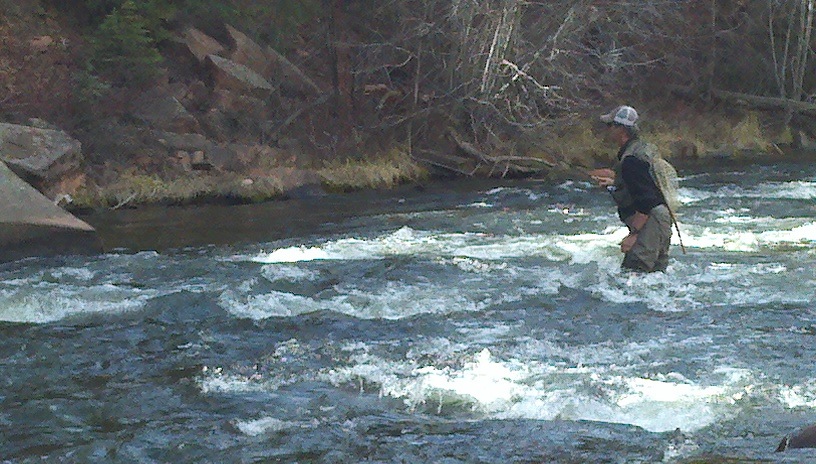
So we take a drive up the Frying Pan looking for some good water to try out this new technique. Frank is pretty easy about where we go and was open to my suggestions being that is what I do for a living. We stop near the 7 mile marker where there is a great mix of pocket water and good runs, it was perfect.
Frank brought two of his new fangled rods, each of different lengths and flex. He hands me the “soft” one then proceeds to give me a short tutorial on how to set this thing up. It is a series of simple slipknots from the tip to the fly. The Tenkara flies are sparse; a hook, some thread, a forward facing hackle, again, simple. When I looked at them, it all started to make much more sense.

He had a process that he liked to follow. Keep the rod retracted and tie on the end of the line, then slowly extend the rod as you carefully unwind the line from the spool. Deliberate, thoughtful. Then we chose a fly and tied it on in my traditional way, a modified clinch knot. We put on zero weight, you fish these flies more like a wet fly, not so much as a Dry or a Nymph.
We hit the river and away we went. The way you fish this rod is as if you are high-sticking pocket water. Sharp, laser-focused casts with emphasis on the action of the fly and less focus on line control. Up to this point, there were very few differences between Tenkara and fly fishing, but this is one of them. There is no “ten to two” motion, more like “ten to noon” motion but curt, prompt, decisive.
At first, I wasn’t really loving this. It seemed rudimentary. I felt amateur, like a kid with a long stick and a leader on it hoping something possibly will take my “bait”. Then, suddendly (and finally) I had a strike. My focus changed. My thoughts went from the rod and awkward process to wondering why I got a fish to take that fly. On my next cast, I stuck him; instinct set in and I reached for the reel, but there was no reel to be found. Calmly panicked, I lifted the fully engaged, beautifully bent rod above my head tin attempt to lead the fish to calmer water. I maneuvered the rainbow to the nearest eddy, carefully grabbed the line and brought him to my net. Grabbing the line this way is taboo in my world as a guide but I apparently common in the Tenkara world. Funny thing is, this is the part I fully enjoyed. It made me realize that I need to take ALL variables into account: where I stand, what I am going to do when I get a fish, looking long term at the short term process and recognizing problems and solutions before you need them. I couldn’t just horse him in or let him run into my backing, I had to antisipate where and what he was going to do with only 12 feet of line attached. I had to think of my positioning and my next ten steps. Nothing is more Zen, becoming exclusive with your environment, simple process for a complicated task. Pretty cool.

I will say this, I will not give up any of my rods and gorgeous reels and replace them with Tenkara rigs, but I will for sure have them as part of my routine as a refreshing change of pace. One thing is for sure, you will find me on any day that the hatch is going strong with a single short line and a long rod pulling fish off the top looking as if I had reached Nirvana. It is that cool.
Be sure to look me up at Taylor Creek Flyshop if you are in the Roaring Fork Valley if you are interested in learning Tenkara and enjoy another level of river philosophy.
Glenn




 Glenn On The Fly